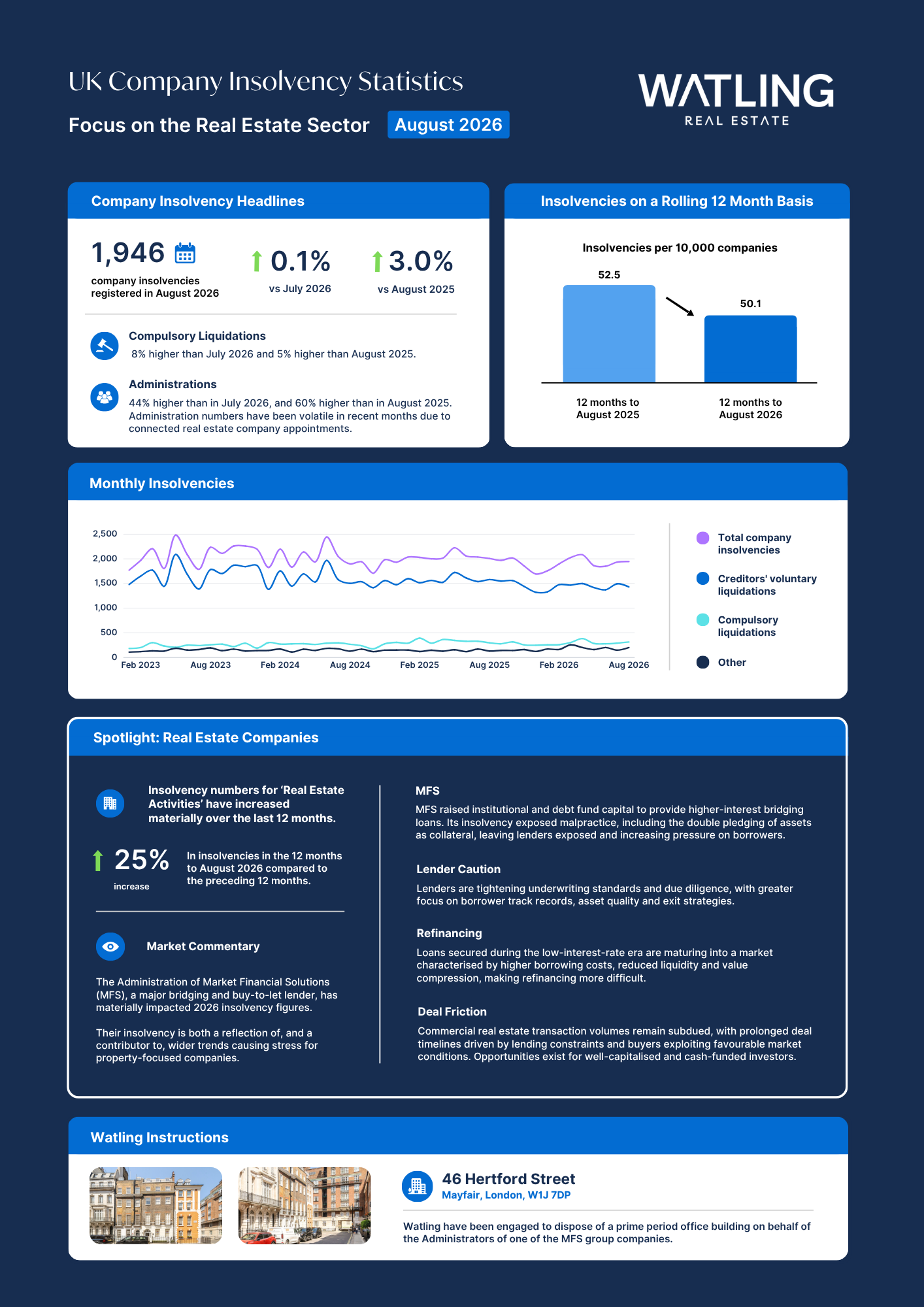



Watling’s review of the August 2026 insolvency statistics showed insolvency numbers were relatively stable, with 1,946 registered insolvencies in England and Wales, representing a 0.1% increase from July 2026 and a 3% increase year-on-year.
Insolvencies on a rolling 12 monthly basis trended marginally down, reducing from 52.5 insolvencies per 10,000 companies in the 12 months to August 2025, to 50.1 in the 12 months to August 2026.
Notably, Administration numbers have been volatile in recent months, being 44% higher in August than in July 2026, and 60% higher than in August 2025.
The Administration of Market Financial Solutions (MFS), a major bridging and buy-to-let lender, and associated companies, has materially impacted 2026 insolvency figures.
Drilling into insolvency numbers for ‘Real Estate Activities’ shows a 25% increase in insolvencies in the 12 months to August 2026, relative to the preceding 12 months.
MFS’ insolvency is both a reflection of, and a contributor to, wider trends causing stress for property-focused companies. We have outlined some of these trends below.
MFS
MFS raised institutional and debt fund capital to provide higher-interest bridging loans. Its insolvency exposed malpractice, including the double pledging of assets as collateral, leaving lenders exposed and increasing pressure on borrowers.
Lender Caution
Lenders are tightening underwriting standards and due diligence, with greater focus on borrower track records, asset quality and exit strategies.
Refinancing
Loans secured during the low-interest-rate era are maturing into a market characterised by higher borrowing costs, reduced liquidity and value compression, making refinancing more difficult.
Deal Friction
Commercial real estate transaction volumes remain subdued, with prolonged deal timelines driven by lending constraints and buyers exploiting favourable market conditions. Opportunities exist for well-capitalised and cash-funded investors.
Download the pdf here